
A stroll in Oxford Botanic Garden makes us realise it somehow all comes down to culture and history in the end. In a series of three blogs, we introduce you to this special garden. This time: an overview of the garden.
Oxford has Britain’s oldest botanic garden within its boundaries. Oxford Botanic Garden was established in 1621 as a physic garden for the study of medicinal plants. Founder was Henry Danvers, the First Earl of Danby. These days, it is home to over 6,000 plant species used in scientific teaching, research and conservation.
The Superintendent and his goat
Bobart the Elder (c1599-1680) was appointed first Superintendent of Oxford Physic Garden. Bobart was an eccentric.
Besides running the garden, he owned a pub on Oxford High Street, called the Greyhound, was accompanied by a goat, and placed pieces of silver in his beard on days of celebration!
Walled Garden
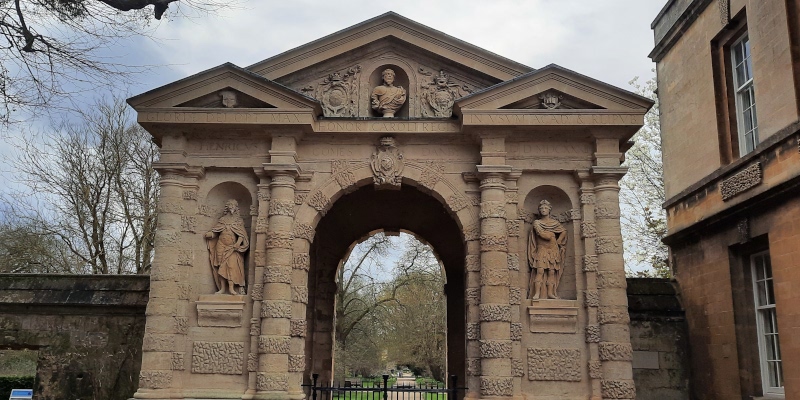
We enter the botanic garden through the impressive Danby Gate (1632-33, pictured above) on High Street. The Walled Garden is the first part of our walk in this green oasis. It dates back to the Oxford Botanic Garden’s foundation and is the garden’s oldest section. Here, we find plant beds that mostly have a rectangular, traditional shape.


Taxonomic Beds
Some of the plant beds here in the Walled Garden have been designed according to the family tree of flowering plants. The chosen plants in these Taxonomic Beds represent the diversity of the plant world.
The group of flowering plants is indeed the most diverse group of land plants. It contains more than 4,000 families, and more than 350,000 species. At Discutafel, we think some knowledge and appreciation of biodiversity is important to create sustainable gardens.
Notice
On the day of our visit, the sounds of Oxford Botanical Garden were overwhelming. The garden maintenance team had chosen this precise moment to produce a lot of noise.
No doubt, their machines did necessary work. However, unlike the production teams of Morse, Endeavor, and other famous TV detective series shot in this old city, your Discutafel podcaster was not in the position to clear the streets and gardens of unwanted stimuli. So we ended up with podcast recordings we eventually had to lay aside.
Therefore, we take you on a very silent stroll through the garden by publishing these blogs. Please note, we describe here the situation during our visit in March 2024. We refer to the garden’s website for updates.
Lower Garden
Just across Danby Arch, on the end of the main path through the Walled Garden, we enter the Lower Garden. The atmosphere changes. We see less rectangular plant beds, and more curved paths.
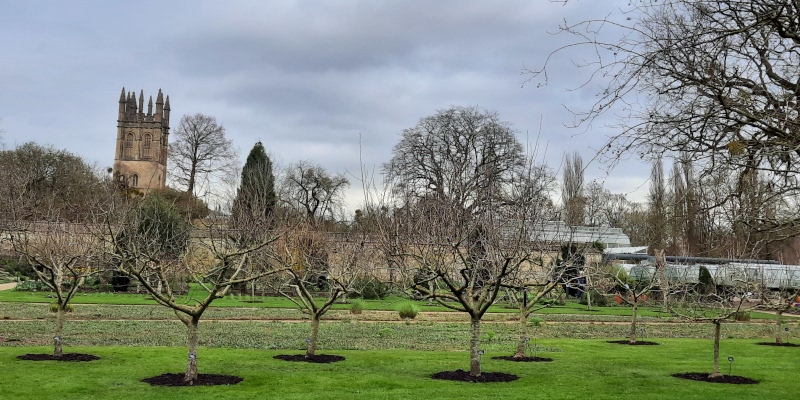
The Merton Borders are an example of sustainable horticultural development, with the aim of having minimal impact on the environment in the long term. At the time of our visit, they apparently have been tidied up to give young plants more air and space.

Plants that changed the World
It’s not all ornamental borders in the Lower Garden. We especially like the Plants that changed the World border. This area shows a collection highlighting plants that have changed the course of human civilisations across the globe. The plantings are a mixture of plants useful for food, medicines, fibres, dyes and much more, all illustrating how important plants are to our existence.
On a map, some places are highlighted. We realise: this is also a story about botanical emigration to Britain and Ireland.
About 10,000 years ago human populations slowly give up their hunter-gather lifestyle and gain some control over plants and animals. After a while, these plants and animals can no longer compete outside cultivation. And people? They cannot live without them. So they depend on each other. Examples of plants that immigrated are maize, and tomato.


Glasshouses
Oxford Botanic Garden has seven display glasshouses now. If you, like your podcaster, are interested in edible plants and other plants for a purpose, you may especially like the Rainforest House. We spotted coffee, sugarcane, cotton and many more plants that gave us their produce.
How to get there
Oxford Botanic Garden can easily be reached by train. It’s entrance is on High Street, just a 20 minutes walk from the station. That is, when you’re not distracted by the beautiful shops and historic buildings in the city!
Links
- Oxford Botanic Garden (HistoryHit)
- Jacob Bobart the Elder (Cabinet)
- The Walled Garden (University of Oxford Botanic Garden & Arboretum)
- The Lower Garden (University of Oxford Botanic Garden & Arboretum)